Better decisions
Evidence-backed, well-reasoned and defensible recommendations for directors and executives.
A governed AI architecture for turning information, evidence and organisational experience into trusted board decisions, stronger governance, controlled implementation and lasting value.
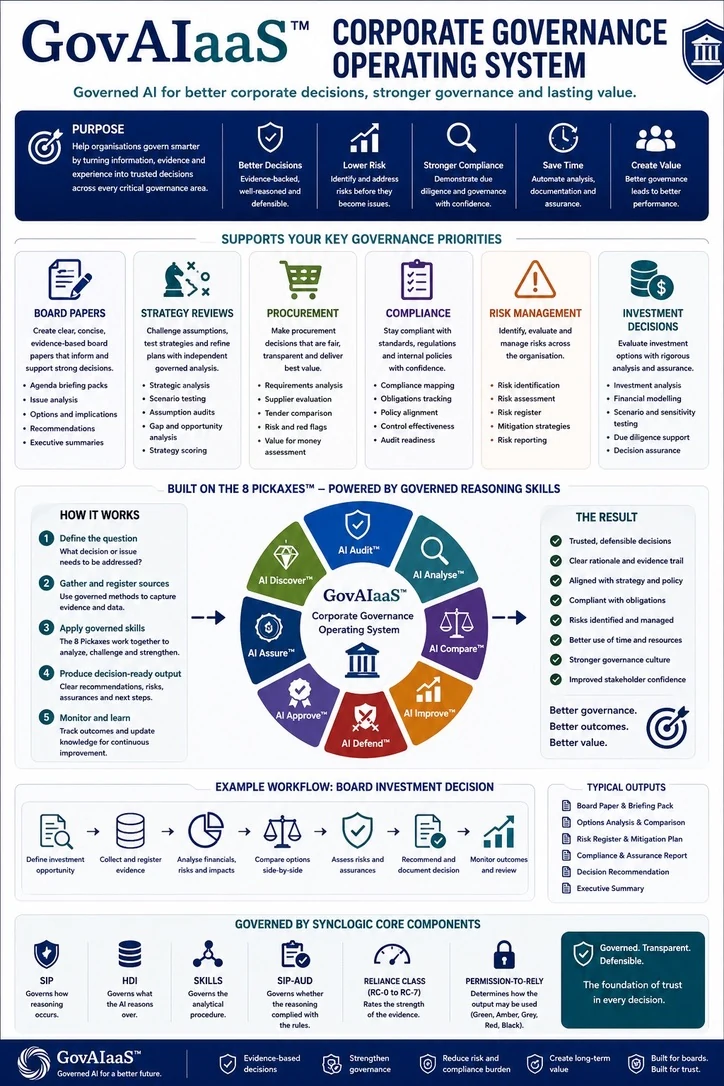 Open the complete operating model
The system replaces scattered documents and one-off AI answers with a repeatable method for defining the question, registering evidence, applying specialist analysis, documenting assurance and monitoring outcomes.
Evidence-backed, well-reasoned and defensible recommendations for directors and executives.
Risks, assumptions, dependencies and weaknesses are identified before they become issues.
Due diligence, obligations, controls and governance requirements remain visible.
Board analysis, briefing packs, documentation and assurance are produced more efficiently.
Strategy and investment choices are tested against alternatives, impacts and expected outcomes.
Clear rationale, traceable evidence and accountable decisions strengthen trust.
Each operation can be deployed separately or combined into an integrated governance environment.
Each module produces structured evidence, options, risks, assumptions, assurance and a clear record of the authorised decision.
Create concise, evidence-based board packs with agenda briefs, issue analysis, options, implications, recommendations and executive summaries.
Challenge assumptions, test plans, build scenarios, identify strategic gaps and compare opportunities using governed analysis.
Register requirements, compare suppliers, analyse tenders, expose red flags and document value-for-money judgements.
Map obligations, policies and controls; monitor regulatory change; assess effectiveness and prepare for audit.
Identify, assess and prioritise risks; test scenarios; document mitigations and improve board-level reporting.
Evaluate financial models, strategic fit, scenarios, sensitivities and due diligence before recommendation and approval.
The operating system combines eight named, repeatable analytical skills. Each has a defined purpose and works under the same evidence, assurance and reliance controls.
Not a generic chatbot: the pickaxes are selected for the decision at hand, operate over registered evidence and produce outputs within a declared Permission-to-Rely.
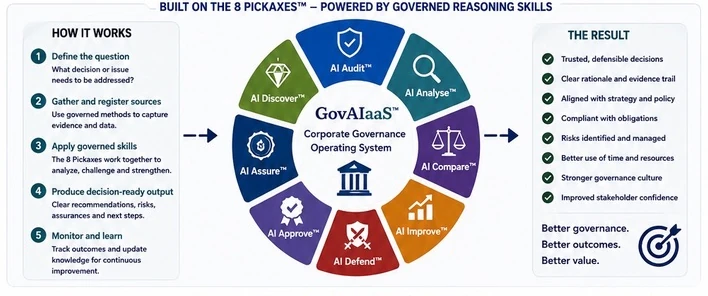 View the pickaxe architecture
The system takes an investment opportunity through definition, evidence registration, financial and impact analysis, option comparison, risk and assurance review, recommendation, documentation and post-decision monitoring.
 Open the board investment workflow
The method controls how reasoning starts, what evidence it uses, how it is tested and exactly what the resulting output is allowed to support.
Defines the task, authority, scope, evidence conditions, assumptions and intended use before analysis begins.
Registers the claims, sources, mechanisms, dependencies, limitations and evidence surface the AI reasons over.
Applies repeatable specialist analytical procedures rather than leaving method selection implicit.
Checks whether the reasoning complied with scope, evidence rules, challenge and governance requirements.
Rates the output from orientation to decision-grade use according to evidentiary and verification strength.
States the permitted use, audience, limitations, review needs and conditions that require reconsideration.
Open the infographic to review the six operating priorities, eight pickaxes, workflow, outputs and SyncLogic governance controls together.